





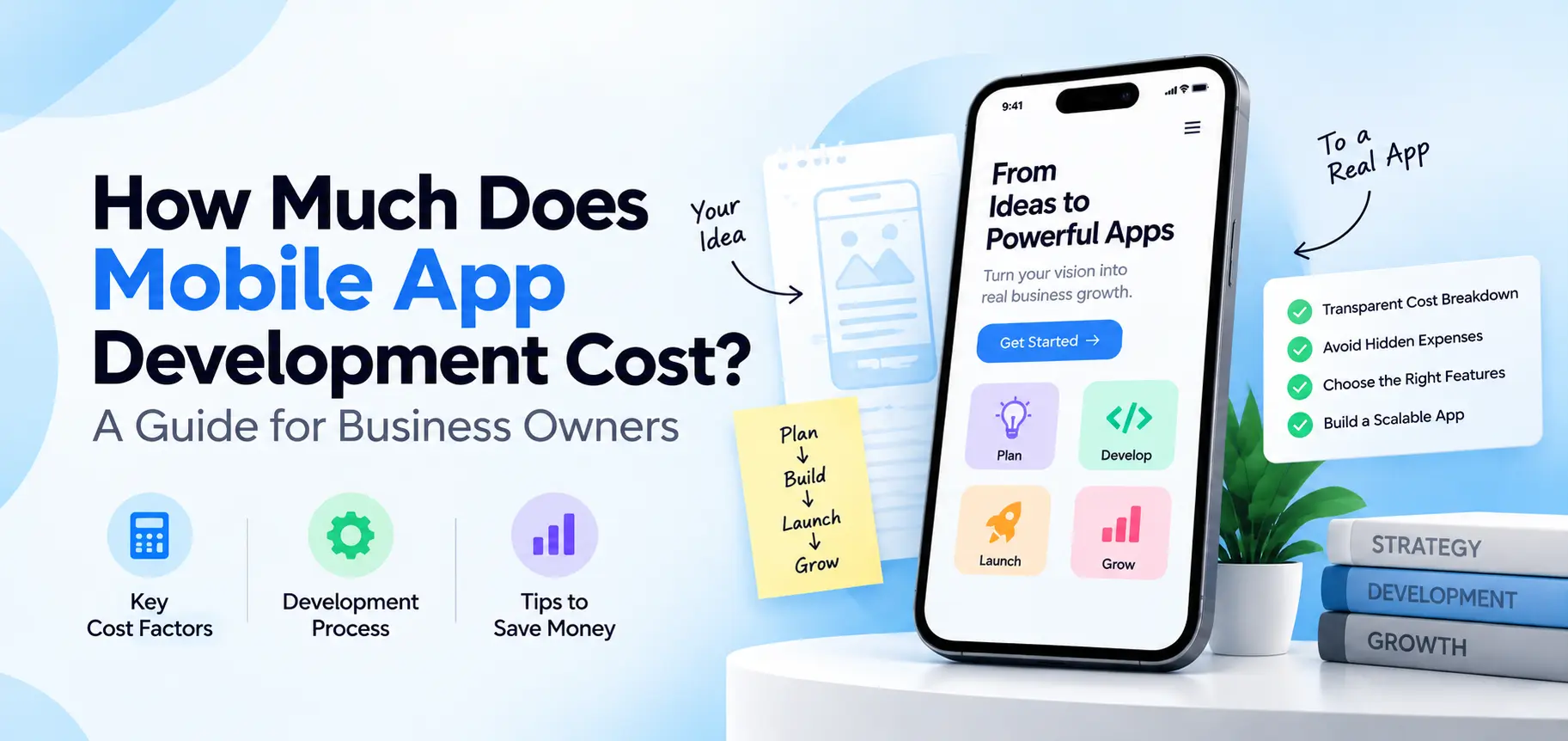
You have an idea for a mobile app. Maybe you want customers to book your services, order products, manage appointments, or access your business on the go.
Before hiring a mobile app development company, you probably have three questions:
This guide explains what affects your budget, which expenses to plan for, and what to ask before starting your project.
A simple mobile app may cost $5,000–$20,000, a medium-complexity app $20,000–$100,000, and a complex app $100,000–$300,000 or more. These are broad planning benchmarks, not fixed prices or a quote for your project.
All figures are in US dollars. Actual pricing depends on requirements, team location, platform choices, and what the development agreement includes.
The lower end generally means tightly limited functionality. A full-featured business platform should not be budgeted like a basic informational app.
The most useful estimate starts with your requirements, not a generic price per screen.
1. Features and business rules:
A feature that sounds simple can involve significant development work.
Consider appointment booking. Allowing customers to select an available time is one scope. Supporting multiple locations, staff schedules, deposits, cancellations, refunds, and reminders is a much larger one.
Before requesting a quote, separate your requirements into:
This creates a clearer budget and helps prevent scope changes during development.
2. iOS, Android, or both:
Your platform choice affects development, testing, and ongoing support.
Native development typically uses platform-specific technologies, such as Swift for iOS and Kotlin for Android. It can be appropriate for apps requiring deep device integration or demanding platform-specific experiences.
Cross-platform development, using technologies such as Flutter or React Native, allows developers to share substantial code between iOS and Android. This can reduce duplicated work, although platform-specific development and testing are still necessary.
Neither approach is automatically better. Choose based on your audience, features, performance requirements, and long-term maintenance needs.
3. Backend systems and integrations:
What customers see is only part of the app.
Your project may also need:
Ask whether these are included in the quote. Two proposals can look similar while covering very different deliverables.
4. Design, testing, and security:
Professional mobile app development involves more than writing code.
Your team needs to consider navigation, accessibility, loading states, unreliable internet connections, and different screen sizes. Testing should cover the complete customer journey, not just whether individual screens open.
Apps handling sensitive information may also require additional security, privacy, and regulatory work.
AI-assisted development tools can help with tasks such as generating routine code, drafting tests, and exploring prototypes. However, faster code generation does not remove the need for product planning, security reviews, device testing, or experienced engineering.
There is also a difference between using AI to build your app and adding AI features to your app.
AI can never help you create a production-level app.
An AI chatbot or document-processing feature may introduce ongoing usage charges, privacy requirements, and additional evaluation work.
When comparing proposals, ask what AI changes about the actual deliverables and budget. Avoid assuming it makes every project cheaper or that your app needs AI simply because the technology is available.
Treat these as planning ranges, not guaranteed launch dates. Requirements, team capacity, feedback cycles, third-party access, and store approval can affect delivery.
A credible project plan should identify milestones for discovery, design, development, testing, and launch. It should also explain which decisions or materials your business must provide.
The development invoice is not the complete cost of owning an app.
Plan for:
Publishing also has account fees. Apple currently lists its Developer Program at US$99 per membership year, while Google lists a US$25 one-time Play Console registration fee. Eligibility, local pricing, and taxes may differ; applicable transaction commissions are separate.
Ask your development partner for a first-year operating estimate, not just a build price.
The cheapest proposal is not necessarily the best value. A useful proposal makes the scope, responsibilities, and costs clear.
Before hiring anyone, ask:
Look for a team that asks thoughtful questions about your customers and business goals before recommending a technology.
Start with a minimum viable product, or MVP: the smallest useful version of your app that solves a real customer problem.
For a service business, that might mean letting customers browse services, book appointments, and receive confirmations. Loyalty rewards, live chat, and advanced personalization could follow once you understand what users need.
An MVP should have fewer features, not weaker security or unreliable core functionality.
You can also control costs by preparing requirements early, consolidating feedback, and avoiding unnecessary custom integrations.
You do not need a complete technical specification to get started. Prepare a short brief explaining who will use the app, the problem it should solve, your essential features, preferred platforms, and budget range.
Looking for a mobile app development partner? Contact our team to discuss your idea and request a project estimate tailored to your business.
Schedule a 1:1 meeting